
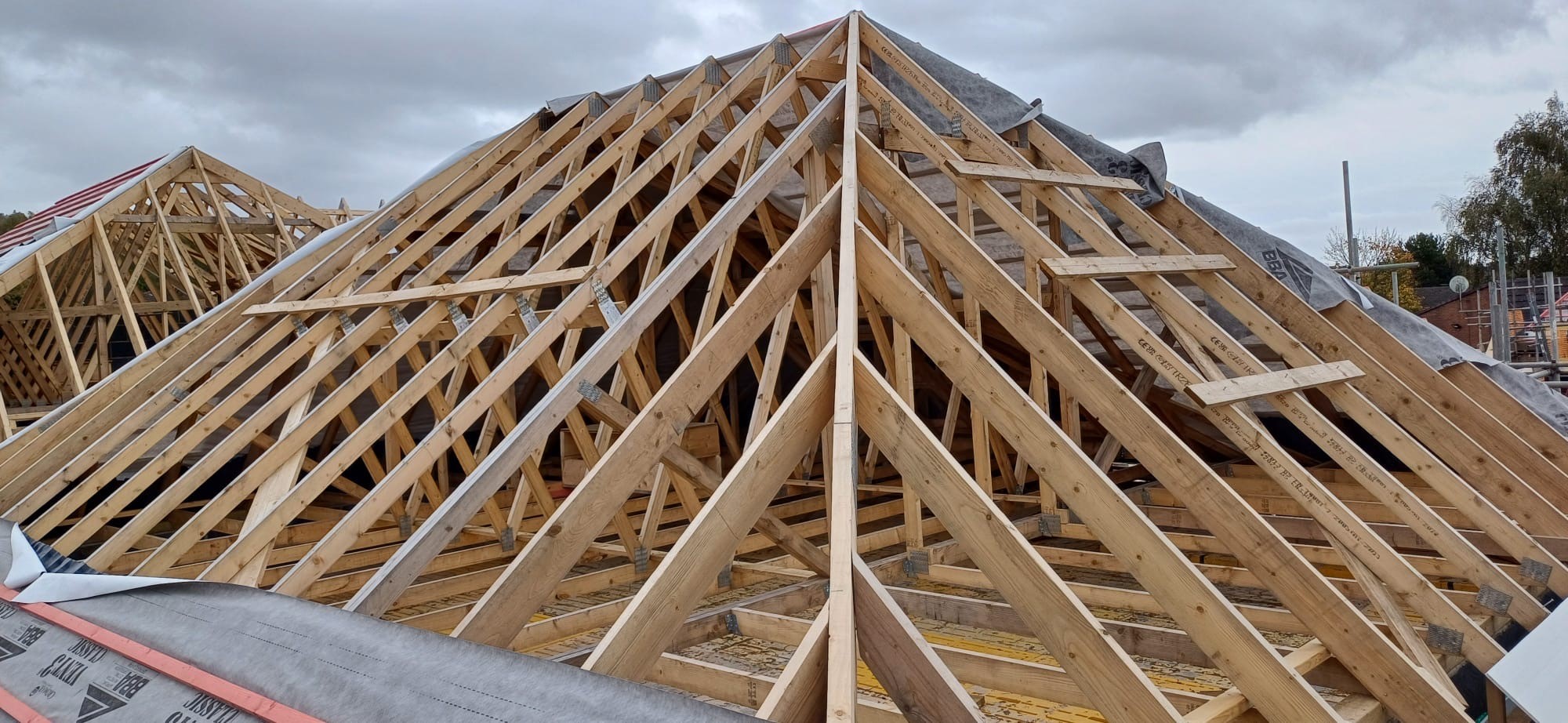

If you’re planning a house extension, loft conversion, or new build, you’ve probably heard the term “roof truss” mentioned by your architect or builder. But what exactly is a roof truss, when do you need one, and how do you go about getting them made?
This guide explains everything in plain English — no jargon, no unnecessary complexity.
What is a Roof Truss?
A roof truss is a pre-engineered, triangular timber frame that supports the roof of a building. Rather than relying on the internal walls of your home to hold the roof up, a truss transfers the weight of the roof directly down to the external walls — which means the space beneath it can be completely open.
Trusses are designed and manufactured off-site to precise dimensions, then delivered to site ready to install. This makes them faster to erect than traditional cut roofs and more consistent in quality.
Why Use Roof Trusses Instead of a Cut Roof?
Traditional cut roofs are built piece by piece by a skilled carpenter working on site. For most extensions and new builds, prefabricated trusses are now the preferred choice. Here’s why:
Speed. A set of trusses can be craned into position and secured in a single day. A cut roof of the same size might take a carpenter several days to complete.
Accuracy. Trusses are engineered and manufactured using precision machinery — every joint, angle and bearing is calculated to exact tolerances.
Cost. The speed of installation usually means lower labour costs, often offsetting the cost of the trusses themselves.
Structural performance. Every truss is designed to specific load requirements, including the weight of your roof covering, wind loads, and snow loads where applicable.
Common Types of Roof Truss
Fink truss (W-truss) — the most common type, used for standard pitched roofs on extensions and new builds.
Attic truss — designed to create usable space within the roof, engineered to take floor loads as well as roof loads.
Hip-end truss — used where the roof slopes on all four sides rather than having vertical gable ends.
Mono truss — a single-pitched truss, often used for lean-to extensions, garages and outbuildings.
Feature trusses — bespoke, visible trusses made in oak or Douglas fir, designed to be part of the interior rather than hidden.
Do I Need a Roof Truss for My Extension?
Most single and double-storey extensions use roof trusses. Whether you need them depends on the roof design your architect has specified. If your drawings show a pitched roof — and most extensions do — trusses are almost certainly involved.
The good news is that you don’t need finalised drawings to get started. At Dunscar Timber Engineering, we’re happy to review early-stage plans and give you an indication of what’s needed and what it’s likely to cost.
What Information Do I Need to Get a Quote?
Getting a roof truss quote is simpler than most people expect. To give you an accurate price, we typically need:
- Your architectural drawings (even early-stage or planning drawings are useful)
- The roof pitch (angle), if known
- The roof covering you’re planning (concrete tiles, clay tiles, slate, etc.)
- Whether you need anything non-standard (attic trusses, feature trusses, unusually large spans)
If you don’t have all of this yet, send us what you have and we’ll tell you what else we need.
How Long Does It Take?
Once we have approved drawings, our typical lead time from order to delivery is 10–15 working days — well within most construction programmes. If your project is time-sensitive, speak to us early.
What Does Dunscar Timber Engineering Supply?
We design and manufacture roof trusses from our facility in Bolton, Lancashire, including:
- Standard fink trusses for domestic extensions and new builds
- Attic trusses for room-in-roof designs
- Hip-end truss sets for hipped roofs
- Mono trusses for lean-to and flat-to-pitch extensions
- Feature trusses in oak, Douglas fir and glulam
We work with homeowners, architects, structural engineers and builders of all sizes — and we’re happy to get involved at the planning stage at no extra cost.
Ready to Get Started?
Whether you have detailed drawings or you’re still at the sketch stage, we’d love to hear about your project.
Call us on [phone] or email [email] and we’ll come back to you within one working day.
Find more project examples at dunscartimber.co.uk and follow us on LinkedIn and Facebook.